As I've stated before, I'm a big fan of rock fiction, so it's cool to see someone's list of their top 40 rock novels. While I've read a couple on the list, including the majority are books and authors I've never heard of. I guess it is time to head down to Powell's to see which ones they have in stock. First up, Lewis Shiner's #1 ranked Glimpses.
Oh yeah, and they included a quote of mine for Peter Guralnick's Nighthawk Blues. Cool.

Showing posts with label rock fiction. Show all posts
Showing posts with label rock fiction. Show all posts
November 11, 2009


October 5, 2009
Matthew Specktor Interview
After reading and enjoying Matthew Specktor's That Summertime Sound I was given the opportunity to ask him a couple questions about the book, the state of his fandom, and other authors who write about music. In the last question there are a couple links to the music that inspired his writing. I guess if you approve, you should go read the book. And if they don't meet your standards, you should probably also read the book since might be the musically obsessive type that he wrote about.
Quickcrit: While many books integrate music into stories, few seem to cross the line into what I call rock fiction. How did you decide to make music such a large part of the book?
Matthew Speckotr: I guess in this case since music was simply the subject of the book. A lot of writers I really love and admire--Don DeLillo, Jonathan Lethem, Michael Ondaatje, Geoff Dyer--have written wonderfully about rock-n-roll and/or jazz. I was thinking about the Midwest, and a set of people I used to know, and the band itself seemed to crystallize a whole set of thematic interests/obsessions. I liked writing about music because it was fundamentally nerdy, too. I was a little embarrassed by the depth of my passion for it, and I figured if I was embarrassed that was probably a good indicator that I might get to something close-to-the-bone.
QC: How comfortable are you with That Summertime Sound being described as rock fiction?
MS: I'm not sure how comfortable I am with the label 'rock fiction,' but that's really because I'm a little at odds with labeling in general. (I don't love the term 'literary fiction,' either.) Genre-tags are for marketers, not fans. Having said that, I think the book does speak--I hope--to the passionate music fan. I am one, and God knows, we're all wound up in our enthusiasm for something. Hopefully, the book will speak to obsession--to passionate fandom--of any kind, as well. Also, lots of writers these days let their musical excitements show through their books. Try Dana Spiotta's phenomenal Eat the Document, for starters.
QC: Are you as obsessed about music as your narrator is?
MS: Yeah. Perhaps not in the same way--I'm twice the narrator's age, and music assumes a different place along one's continuum-of-needs as one gets older--but, I'm afraid, to the same degree. I still love loud, rackety garage rock and punk as much as I ever did. I also love certain things I would've found ideologically appalling when I was that age. I played a David Crosby record this morning. I can imagine the look on my narrator's face to hear about that.
QC: Were the Lords of Oblivion completely fictional or did you have particular band in mind as a rough template?
MS: Completely fictitious. Any similarity between 'Nic Devine' and the neglected genius Mick Divvens, former front man of the wonderful Boys From Nowhere, are strictly coincidental. (Heh. No, the band in the book is most definitely modeled on Boys From Nowhere. They're very much a real band.)
QC: Were you at all tempted to create a soundtrack or playlist to accompany the book?
MS: Well, I've done as much for a number of blogs, lately. (Largeheartedboy, Revolt Media, Owl & Bear.) I may post a more comprehensive list of things I was listening to while I wrote on my own site, shortly. I admit, I'm a sucker for writers' & musicians' recommendations and playlists. This book certainly suggests quite a bit of listening material, and if it encourages people to seek out some of these bands, so much the better.
Matthew Speckotr: I guess in this case since music was simply the subject of the book. A lot of writers I really love and admire--Don DeLillo, Jonathan Lethem, Michael Ondaatje, Geoff Dyer--have written wonderfully about rock-n-roll and/or jazz. I was thinking about the Midwest, and a set of people I used to know, and the band itself seemed to crystallize a whole set of thematic interests/obsessions. I liked writing about music because it was fundamentally nerdy, too. I was a little embarrassed by the depth of my passion for it, and I figured if I was embarrassed that was probably a good indicator that I might get to something close-to-the-bone.
QC: How comfortable are you with That Summertime Sound being described as rock fiction?
MS: I'm not sure how comfortable I am with the label 'rock fiction,' but that's really because I'm a little at odds with labeling in general. (I don't love the term 'literary fiction,' either.) Genre-tags are for marketers, not fans. Having said that, I think the book does speak--I hope--to the passionate music fan. I am one, and God knows, we're all wound up in our enthusiasm for something. Hopefully, the book will speak to obsession--to passionate fandom--of any kind, as well. Also, lots of writers these days let their musical excitements show through their books. Try Dana Spiotta's phenomenal Eat the Document, for starters.
QC: Are you as obsessed about music as your narrator is?
MS: Yeah. Perhaps not in the same way--I'm twice the narrator's age, and music assumes a different place along one's continuum-of-needs as one gets older--but, I'm afraid, to the same degree. I still love loud, rackety garage rock and punk as much as I ever did. I also love certain things I would've found ideologically appalling when I was that age. I played a David Crosby record this morning. I can imagine the look on my narrator's face to hear about that.
QC: Were the Lords of Oblivion completely fictional or did you have particular band in mind as a rough template?
MS: Completely fictitious. Any similarity between 'Nic Devine' and the neglected genius Mick Divvens, former front man of the wonderful Boys From Nowhere, are strictly coincidental. (Heh. No, the band in the book is most definitely modeled on Boys From Nowhere. They're very much a real band.)
QC: Were you at all tempted to create a soundtrack or playlist to accompany the book?
MS: Well, I've done as much for a number of blogs, lately. (Largeheartedboy, Revolt Media, Owl & Bear.) I may post a more comprehensive list of things I was listening to while I wrote on my own site, shortly. I admit, I'm a sucker for writers' & musicians' recommendations and playlists. This book certainly suggests quite a bit of listening material, and if it encourages people to seek out some of these bands, so much the better.
September 23, 2009
That Summertime Sound (2009)
 That Summertime Sound is a fun new novel by Matthew Specktor that documents a young man's ill-spent summer vacation in 1980s Columbus, Ohio, drinking, fumbling through romance, and obsessing over a local rock band. Like a younger brother to Nick Hornby's Rob Gordon and Roddy Doyle's Jimmy Rabbite, the narrator is driven to distraction by a passion, but not a talent, for music. The book is packed with critical ruminations on the essence of rock n' roll and references to cool bands, albums, and songs. At times it reads a bit like music nerd porn – Sonic Youth plays on the jukebox and everyone's record collection is hip and obscure. I found the level of musical detail slightly distracting from the story and overly demonstrating the narrator's precociousness until I realized that it allowed me to create a soundtrack in my head as I read along. Quite a few times, it sent me rifling through my music collection to revisit a particular album, like Sisters/Lovers or Talking Heads: 77. And the story is good too. Specktor captures those late teenage years when boys are much better equipped to discuss the merits and influences of their favorite bands than actually listen to, and have a relationship with a young woman.
For a sample, listen to sections of the book read by James Fanco, Gwyneth Paltrow, and Morgan Freeman!
October 4, 2008
The Wishbones: A Novel (1997)
 This novel follows another bunch of relatively unsuccessful musicians. These are losers of the Rob Fleming variety - unromantic failures living in suburban New Jersey, in their mid-30s but still staying with their parents, trudging through crap jobs, with only their wedding band providing them with any pleasure in their lives. Also like Rob, they seem to be stuck in perpetual inertia about moving forward in their lives, whether that means getting married, finding a job with with consistent hours, or at least not driving while slogging down cheap beer. The main character, Dave, stumbles through the narrative thinking about, but not actually making decisions. Rather, he seems to content to let life happen to him. As a result, his life kind of sucks. It's a quick reminder how the rock n' roll lifestyle that seems carefree and glamorous when you're young, seems sort of pathetic once you no longer are.
September 30, 2008
Anything Goes: A Novel (2002)
 More rock fiction. This one bums around with a blues cover band as they run a circuit through dives and roadhouses up and down the East Coast. Madison Smartt Bell's story follows a young bassist as confronts his fathers abuse, enjoys the late night/early morning attentions of various women on the road, and nurses the repercussions of an encounter with violent frat boys. I guess it is a coming of age story, if learning to write songs signifies maturity. Although there are some dark moments, those are mostly just ruminations on the characters' pasts. It reads fast and fun - a simple story spiced up with a couple colorful characters, plenty of band decisions washed down with rail whiskey, and lots of music talk. The characters are all fans of music they cover as much as they are musicians. Their ruminations on topics like Emmylou Harris' voice and guitar solos, were some of my favorite sections. Oh, and the lead character's name is Jesse. Cool.
September 24, 2008
Reservation Blues (1995)
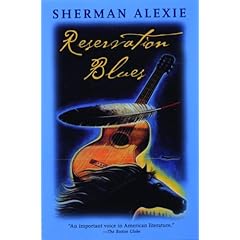 Although this is yet another rock novel written by one of my favorite writers, this book is strikingly different. Sherman Alexie's book follows a group of American Indians who form a garage band after acquiring Robert Johnson's cursed guitar, which makes whoever plays it sound amazing. What sets this book apart is how Alexie reframes and plays with the mythology surrounding sex, drugs, and rock n' roll, integrating in American Indian mysticism, fatalism, and alcoholism. In doing so, he focuses on the pain that is released and the stories that must be told through the music. Like his other novels, the characters are both humorous and tragic. As they deal with their history, politics, and life on the reservation, he makes a convincing argument that American Indians know what it means to have the blues. They feel the blues: it surrounds, weighs down, and sometimes destroys them. By bashing it out on beat up electric guitars and cheap keyboards they share their experience. The cliché of the tortured and haunted artist has never seemed so fresh.
August 21, 2008
Never Mind the Pollacks: A Rock and Roll Novel (2004)
 More rock fiction! I think as a general rule satires are hit and miss. Neal Pollack does a decent job at skewering rock critics and rock mythology, but sometimes it reminds me a little too much of Forrest Gump, as the main character (a fictional Neal Pollack) influences the careers of Elvis, Dylan, Lou Reed, Iggy Pop, and Kurt Cobain. At its worst it reminds me of one of those Not Another (Teen/Scary/Date/Superhero) Movies where all the clichés, jokes and riffs are smashed up together in more or less a jumbled mess. But just as with Forrest Gump, sometimes it's fun to imagine the little behind-the-scenes moments surrounding historical (and musical) events.
August 10, 2008
Nighthawk Blues: A Novel (1980)
 Peter Guralnick is my favorite music writer. His book Sweet Soul Music led me deep into a southern soul fixation that cost me more money than I'd like to consider and kept me removed from indie and alternative rock for most of the 90s. He mostly writes roots music-related biographies or histories, so this fictional book is a slight departure from his usual work, and likely why I never picked it until now. As a story, it's just fine, detailing the life of an aging blues guitarist much the way he does in his other books. But since this is fiction, he uses the complicated relationships between the artist, his white fan/manager and white female protege to explore authenticity, reverence, and performance. While those concepts are still relevant, they're discussed differently now, making the book feel a bit dated. Then again, maybe I've read too much cultural theory.
Subscribe to:
Posts (Atom)